Capabilities
The list your engineer asked for. What we will quote, how fast it goes, how much power it handles, and the standards it is drawn to.
Read this as scope with receipts. Under each group is what we have actually shipped for it: stackup, numbers and what happened in service, with no client names. The two boards above are the ones we can show; the rest belong to their owners. Every quote is priced from pin count and topology by the same rules, and an engineer reviews it before it binds.
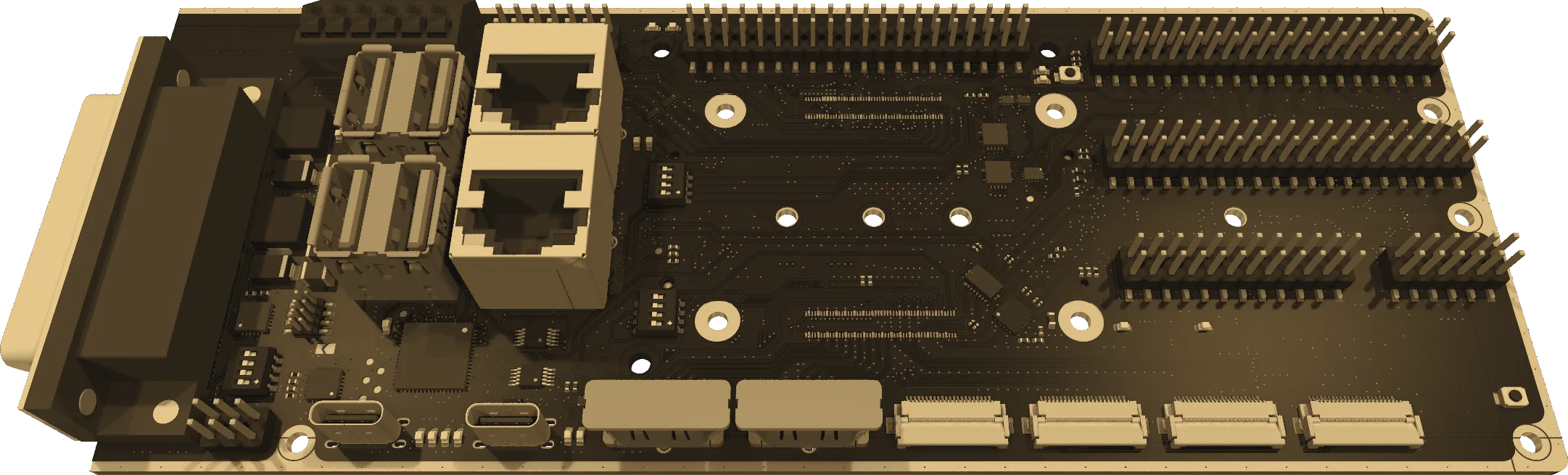
Industrial compute-module carrier
Two weeks · four layers · dual Ethernet, USB, HDMI
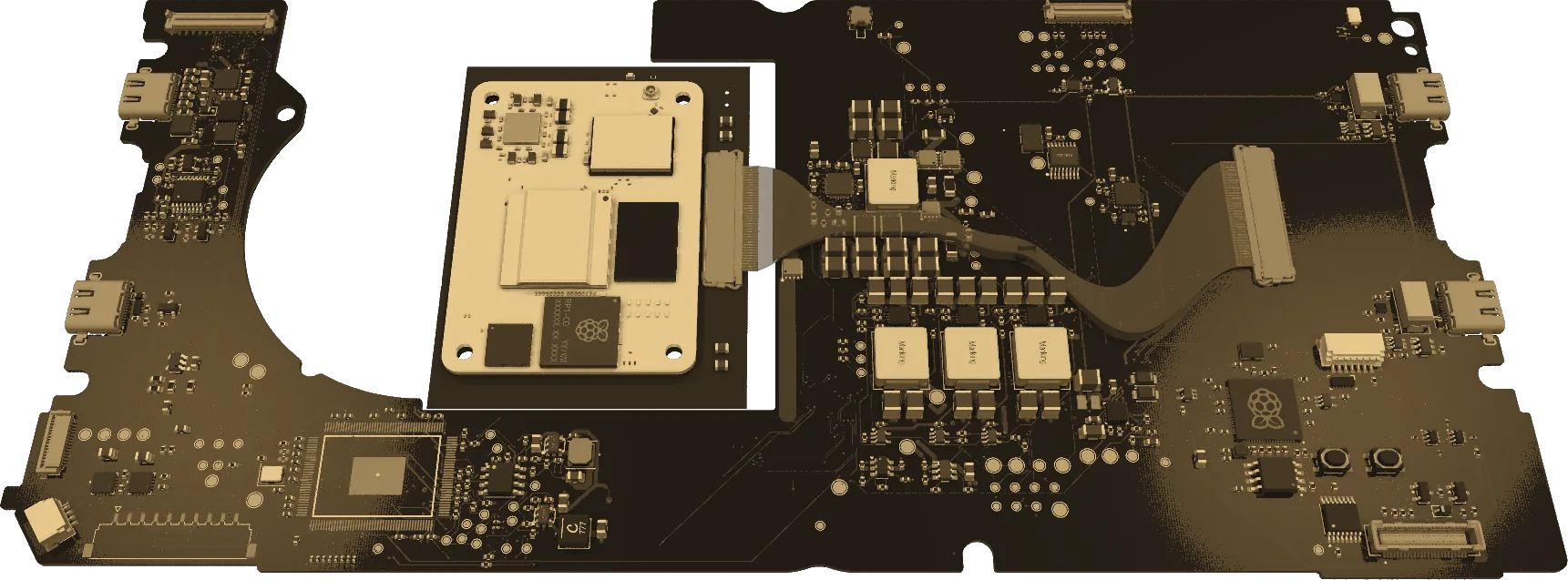
Laptop mainboard, CM5 in a Framework 13
Eight layers · USB 3, PCIe, eDP · USB-C PD charging
Digital and High Speed
From an 8-bit controller on two layers to a compute module with a memory bus and four PCIe lanes. What decides the price is topology, not data rate: one point-to-point link is routine, a DRAM bus or a fabric of lanes is where the hours go.
- Microcontrollers
- 8-bit AVR and PIC; Arm Cortex-M0+, M3, M4, M7, M33 and M55 (STM32, NXP LPC and i.MX RT, Microchip SAM, Nordic nRF52/53/54, Renesas RA, TI MSP430 and C2000, Silicon Labs EFR32); Espressif ESP32 and RISC-V parts; Raspberry Pi RP2040 and RP2350. Crossover MCUs with external SDRAM, HyperRAM or octal-SPI flash.
- Application processors and modules
- Raspberry Pi CM4 and CM5 carriers; NXP i.MX 6, 8 and 9; TI AM62 and AM64; Rockchip RK3566 and RK3588; Allwinner; NVIDIA Jetson Orin modules. System-on-module carriers or memory-down designs around the bare SoC.
- USB
- USB 1.1 and 2.0 through 3.2 Gen 1, Gen 2 and Gen 2×2, and USB4 at 20 and 40 Gbit/s. USB-C with Power Delivery (sink, source, dual-role, EPR to 240 W), DisplayPort alternate mode, orientation muxes, redrivers and retimers, hubs and PD controllers.
- Thunderbolt
- Thunderbolt 3 and 4 ports and docks built on Intel and ASMedia controllers and retimers, laid out to the reference channel budgets; certification runs through an authorised lab, and we support it.
- PCI Express
- Gen 1 to Gen 5, x1 to x16: root complex to slot, M.2 M-, B- and E-key, OCuLink and cabled links, packet switches, clock buffers and generators, redrivers and retimers. Lane reversal, polarity inversion and the reference-clock architecture handled at schematic time.
- Memory
- DDR3, DDR3L, DDR4 and DDR5; LPDDR3, LPDDR4, LPDDR4X and LPDDR5. Memory-down in point-to-point, fly-by and T-topologies with Vref, ODT and length and skew matching to the controller vendor rules. eMMC 5.1, UFS, SD and SDIO, QSPI and octal-SPI NOR, HyperRAM.
- FPGAs
- Lattice iCE40, ECP5, CrossLink-NX and Certus; AMD Spartan-7, Artix-7, Kintex-7, Zynq-7000 and Zynq UltraScale+; Intel Cyclone 10 and Cyclone V, Arria 10; Microchip PolarFire and SmartFusion. With or without discrete DDR3, DDR4 or LPDDR4; transceiver breakout to SFP+, JESD204B/C converters and PCIe; configuration flash and power sequencing.
- Networking
- 10/100/1000BASE-T over RGMII, RMII and SGMII PHYs with magnetics and PoE; 2.5G and 10GBASE-T; SFP and SFP+ cages; managed and unmanaged switch ICs; TSN-capable parts on request. Wi-Fi 6 and 6E, Bluetooth 5.x, Thread and Zigbee, LoRa, LTE-M, NB-IoT and 5G modules; GNSS.
- Display and camera
- HDMI 1.4, 2.0 and 2.1; DisplayPort and eDP; LVDS and V-by-One; MIPI DSI and CSI-2 to four lanes; bridges between them (HDMI to eDP, DSI to LVDS); timing controllers, backlight drivers and touch controllers.
- Industrial buses
- CAN and CAN FD, RS-485, RS-422 and RS-232, EtherCAT and Modbus, IO-Link, 4 to 20 mA loops, 24 V digital I/O; galvanic isolation on every one of them where the installation calls for it.
- Signal integrity
- Controlled impedance at 50 Ω single-ended and 85, 90 and 100 Ω differential on catalogue stackups; length and skew matching, back-drilling, via-stub control, unbroken reference planes, crosstalk budgets. Pre-layout simulation for DDR, PCIe and USB channels on request.
Built
- PCIe Gen 2 x1 fanned out to four USB 3.0 ports on a Raspberry Pi CM4 carrier, with gigabit Ethernet and a 20-way harness connector: a µPD720201 bridge given a custom EEPROM so the stock Pi kernel drives it, on a 4-layer impedance-controlled 2116×3 stackup, 72 mm wide to sit on a DIN-rail mount. Used on robot elbows to collect data from USB 3 depth cameras.
- A CM4 interposer on six layers with a 0.4 mm-pitch BGA: on-board eMMC over octal-SPI and an SD slot over quad-SPI, switched through a repurposed Ethernet mux, a supercapacitor bank that holds the module up long enough to shut down cleanly when power drops, and USB-C for flashing without a carrier. $26.80 a unit at fifty, assembled.
- The photographed carrier above: CM4 with an STM32H7 co-processor, a USB hub, gigabit and 100 M Ethernet, two HDMI and DSI, with USB-C Power Delivery. Its successor carries a CM5 with a three-port gigabit switch, a USB 3 hub, two M.2 slots on PCIe Gen 3 and an isolated IO-Link transceiver.
- A quadrature bridge: a dedicated processor counting four encoders at once and handing delta and direction over I2C and UART, with an RS-422 adapter for industrial encoders. Two layers, built for cost, one per axis.
- A DIN-rail IO unit for a lumber-measuring table: logic board plus a front-panel connector board on a right-angle connector, reading motors and encoders and a 24 V push-pull encoder line for an industrial inkjet printer. Replaced $3,500 of catalogue IO per system with under $800.
Power
Everything from a coin cell to a kilovolt. Motor drives and switching supplies are our bread and butter; the specialised end (high voltage, vacuum, isolation) is where a board most needs to be drawn by someone who has done it before.
- Switch-mode supplies
- Buck, boost, buck-boost and SEPIC; multiphase and point-of-load down to 0.8 V at tens of amps; PMICs and LDOs; sequencing, supervision and power-good trees; hot-swap, eFuse and ideal-diode ORing; inrush and reverse-polarity protection.
- Isolated and off-line
- Flyback, forward, LLC and phase-shifted full bridge; power-factor correction; universal 85 to 265 V AC input with EMI filtering; reinforced isolation to the safety standard that applies; planar magnetics. From a few watts to the low kilowatts.
- Motor control
- Brushless DC and PMSM electronic speed controllers, sensorless and field-oriented; stepper drivers; brushed H-bridges and servo stages; gate drivers with silicon, GaN and SiC switches; shunt and Hall current sensing; buses from 12 to 400 V DC, regenerative and dynamic braking.
- High voltage
- Kilovolt-class supplies for piezo drivers, electrostatic actuators, photomultiplier and SiPM bias, X-ray and ion sources, electron guns and electrophoresis; Cockcroft-Walton multipliers and HV flybacks; precision high-voltage amplifiers; creepage, clearance and coating done to IEC 60664-1.
- Vacuum and scientific
- Ion-pump controllers, ion-gauge and Pirani electronics, filament and thermionic-emitter supplies, feedthrough interfacing; in-vacuum boards on low-outgassing polyimide laminates with venting, no-clean processes and no trapped volumes; cryogenic and UHV considerations in material choice.
- Batteries
- Li-ion, LiPo and LiFePO4 from 1S to 16S: chargers with USB-C PD input, protection and battery-management ICs, fuel gauges, balancing; supercapacitor banks; solar MPPT and energy harvesting; pack rules from UN 38.3 and IEC 62133 built in from the start.
- Power over Ethernet
- IEEE 802.3af, at and bt powered devices and sourcing equipment, isolated and non-isolated; USB-C PD sources to 240 W.
- Thermal
- Copper weight and pours, thermal vias, heat-sink and metal-core boards, derating and hot-spot estimates from the layout before the first prototype.
Built
- Four-axis controller for a truss-building robot arm: 42 to 60 V hot-swap input, mezzanine stepper drivers at over 250 W per channel with 1/256 microstepping, driving electromagnets and break-beam sensors in a hostile EMI environment. Single-sided placement; $45 a unit at twenty. Revision 2 put the CM4 on the board and standardised its IO on the CM4-IO reference.
- The driver module itself: one bipolar stepper per module, 44 to 60 V, 250 W sustained at 2.8 A RMS per coil with active cooling, the motor connector on the module so a coupler failure cannot eject it. Four layers of 2 oz copper; $9.50 a unit at thirty.
- Sixteen-channel 24 V open-collector output board sinking 2 A per channel from 3.3 V logic, single-sided for cheap assembly. Thirty-five units across five production lines, one hardware fault in the first year, a running MTBF of 72,800 hours.
- A 4.5 W LED ring for machine vision, bright enough to light a room from a USB 2.0 port, brightness and colour temperature set over I2C or by voltage. Revision 2 moved to an STM32, connectorised power and control, and went single-sided so it mounts flush on a heatsink.
- An IoT storage-unit controller with four 12 V pass-through inputs so tens of units chain off one supply, and a conversion scheme that fires a high-current solenoid without spiking the peak draw. Under $16 a unit assembled at fifty.
Analog, RF and Sensing
The quiet part of the board. Microvolt front ends, radios that pass their tests the first time, and clocks that stay put.
- Precision measurement
- 16- to 32-bit delta-sigma and SAR converters and precision DACs; instrumentation and chopper amplifiers; thermocouple, RTD and thermistor front ends; strain gauges, load cells and bridges; photodiode and transimpedance stages, APD and SiPM readout; potentiostats for electrochemistry; shunt, Hall and fluxgate current sensing.
- Audio
- Codecs, Class-D amplifiers, microphone arrays, I2S and TDM buses, headphone drivers and mute and pop control.
- Radio
- Sub-GHz and 2.4 GHz radios (LoRa, Bluetooth, Wi-Fi, Zigbee and Thread), cellular and GNSS, UWB, NFC and RFID; PCB and chip antennas with matching networks; 50 Ω controlled lines and coaxial launches; pre-certified modules where a module makes the schedule.
- Timing
- Low-jitter clock trees, PLLs and jitter cleaners, TCXO and OCXO references, PTP-capable PHYs, clock distribution across boards.
- Sensors
- Inertial units, time-of-flight and LiDAR front ends, ultrasonic, radar modules, environmental and gas sensors, encoders and resolvers.
Built
- A load-cell front end on that storage controller: a dedicated analogue regulator holding under 0.75 mV of ripple at the 1.3 MHz switching harmonics, so readings repeat to the ADC’s own specification rather than the wiring’s.
- Quadrature and RS-422 line receivers, 24 V push-pull encoder inputs and open-collector outputs that live inside and outside wiring cabinets on a factory floor.
Boards, Mechanics and Manufacturing
The offer ends with ten assembled boards, so the manufacturing is not somebody else’s problem. Stackups come from the fabricator’s catalogue, and the design is checked against their limits before it leaves us.
- Board types
- Rigid from 1 to 16 layers; flex and rigid-flex to IPC-2223; HDI with microvias, via-in-pad and any-layer builds; metal-core; heavy copper to 4 oz; high-Tg, halogen-free and high-frequency laminates (Rogers, Megtron) where the signal needs them.
- Assembly limits
- 0.4 mm-pitch BGA and QFN, 0201 and 01005 passives, package-on-package, press-fit and through-hole, double-sided reflow, selective wave.
- Finishes and materials
- ENIG, ENEPIG, immersion silver, HASL and OSP; edge plating and castellations; controlled-depth routing; conformal coating to IPC-CC-830 and potting.
- Mechanical fit
- STEP exchange in both directions, enclosure and connector placement, keep-outs, mounting and stiffeners; the board checked in the housing before fabrication.
- Design for test
- Test points and boundary scan, bed-of-nails and functional-test fixtures, fiducials and panelisation, firmware bring-up support on the first units.
- Production
- Fabrication and assembly through partner plants in Shenzhen, parts sourced with approved alternates, cable assemblies and harnesses, small-series production after the first ten.
Built
- Stackups from 2-layer 1 oz through 4-layer 1/0.5 oz with 2116×3 resin cores for controlled impedance, to 6-layer 1/0.5/0.5 oz with a 0.4 mm BGA. Board thicknesses down to 0.8 mm where the housing asks.
- Assembled unit prices at small batch, fabrication and assembly included: $9.50 at thirty for a driver module, under $16 at fifty for a controller, $26.80 at fifty for the six-layer BGA interposer, $45 at twenty for the four-axis controller.
- Single-sided placement wherever it pays, mezzanine modules for the hot parts, two-part DIN-rail assemblies with a front-panel board. A 1206-passive development board went from tape-out to finished fabrication in 24 hours.
Standards and Qualifications
Short on purpose. The first group is true of every board that leaves here; the second depends on what the product is, and we will say which apply in the quote. Compliance testing is done by accredited laboratories; our part is to draw the board so it passes and stay with it through the report.
- Every board
- IPC-2221 / 2222 / 2223board design, rigid and flex
- IPC-7351land patterns
- IPC-6012 / 6013fabrication, Class 2 by default, Class 3 on request
- IPC-A-610assembly acceptance, Class 2 by default, Class 3 on request
- RoHS 3 / REACHcompliant parts and laminates, declarations on the BOM
- UL 94 V-0laminates
- When the product calls for it
- FCC Part 15 / CISPR 32emissions, with IEC 61000-4 immunity; pre-compliance before the lab
- IEC 62368-1 / 61010-1 / 60601-1the safety standard that applies, with creepage and clearance to IEC 60664-1
- USB-IF / PCI-SIG / JEDECinterface electricals designed to the specification; logo programmes via lab
- UN 38.3 / IEC 62133lithium packs
What You Receive
Ten assembled boards, and everything needed to make the next thousand without us.
- Source
- KiCad native, the complete project; Altium on request. Schematics as PDF with a reading order, not a pile of sheets.
- Manufacturing data
- Gerber X2, ODB++ or IPC-2581; drill and pick-and-place; stackup and impedance report; assembly drawings; a bill of materials with manufacturer part numbers and approved alternates.
- Mechanical
- STEP of the assembled board and the board outline as DXF.
- Verification
- ERC and DRC reports against the fabricator’s rules, a bring-up and test procedure, and the design notes: what was chosen, and why.
Not on the list? Ask anyway. The answer is a straight one.